Which Option in Control Panel Is Used to Review
Description of each category and icon in the Control Panel
Updated: 06/02/2020 by Computer Promise
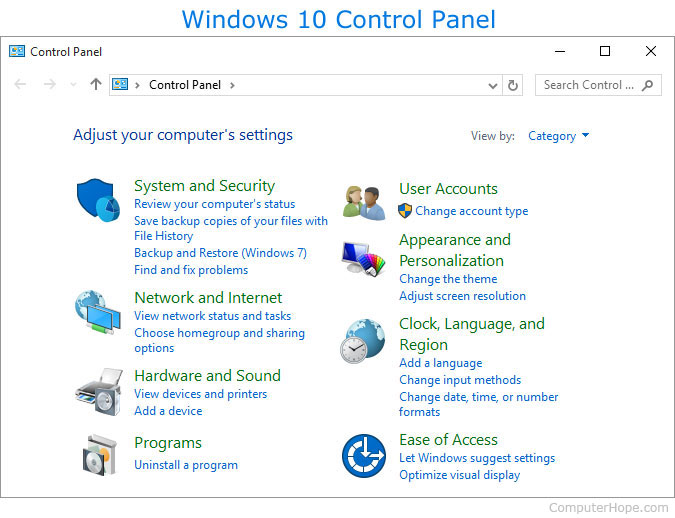
Since its introduction in Windows 95, the Command Panel has undergone many changes including calculation, renaming, and removing of icons and the introduction of categories. This page helps requite you a amend understand the Control Panel, help find where a setting may be adjusted, and give a complete overview of what's bachelor in the Windows Control Panel. Beneath is a visual example of the Windows ten Command Console.
Tip
In Windows 7, Windows 8, and Windows 10 you lot can use the search in the top-right corner of the Command Console window to find the expanse you're looking to adjust. For case, you could blazon "firewall" to search for the Firewall settings. You tin can also use the Windows search in the Taskbar to notice Windows settings and tools available through the Command Panel.
Tip
In all new versions of Windows, y'all can adjust how the Control Panel is shown by changing the View by option. In the top-right corner of the Command Panel, change the View by from Category to Large icons or Modest icons to see only icons.
Note
In Windows 10 and Windows eight, Microsoft is trying to transition users away from using the Command Console in favor of the Windows Settings. However, the Control Panel is still accessible in all versions of Windows.
Annotation
In Windows 7 and Windows 10, some options may have a shield next to the links (  ) that indicates UAC may prompt you for approval if settings are inverse.
Below is a listing of each of the categories that are found in the Windows Control Panel. Click i of the links below to jump to a section or curlicue through them all to learn more than about the Command Panel.
Command Panel categories
- Appearance and Personalization
- Clock, Language, and Region
- Ease of Access
- Hardware and Sound
- Network and Cyberspace
- Programs
- System and Security
- User Accounts
Command Console icons
- Action Heart
- Administrative Tools
- AutoPlay
- Fill-in and Restore (Windows 7)
- BitLocker Drive Encryption
- Broadcom Control Suite
- Color Management
- Credential Manager
- Appointment and Time
- Default Programs
- Desktop Gadgets
- Device Director
- Devices and Printers
- Brandish
- Ease of Access Eye
- File Explorer Options
- File History
- Flash Player (32-flake)
- Folder Options
- Fonts
- Getting Started
- HomeGroup
- Indexing Options
- Infrared
- Internet Options
- Java (32-bit)
- Keyboard
- Language
- Location and Other Sensors
- MobileMe
- Mouse
- Network and Sharing Center
- Notification Area Icons
- NVIDIA Control Console
- Parental Controls
- Performance Data and Tools
- Personalization
- Telephone and Modem
- Power Options
- Programs and Features
- Realtek HD Audio Manager
- Recovery
- Region
- RemoteApp and Desktop Connections
- Security and Maintenance
- Sound
- Speech Recognition
- Storage Spaces
- Sync Center
- System
- Taskbar and Navigation
- Troubleshooting
- User Accounts
- Windows Anytime Upgrade
- Windows CardSpace
- Windows Defender
- Windows Firewall
- Windows Alive Linguistic communication Setting
- Windows To Become
- Windows Update
- Work Folders
Appearance and Personalization
The Appearance and Personalization category allows you to change the look and feel of Windows, which includes adjusting the theme, screen saver, and taskbar. Below is a listing of each of the subcategories of Appearance and Personalization in Windows 10.
Taskbar and Navigation - Opens the Taskbar settings that allow yous to change how the taskbar is shown or hidden, its location, icons, and other settings.
Navigation properties - Opens the Taskbar settings window (same as above).
Ease of Admission Center - Opens the Ease of Admission Center, which gives you access to all settings that makes Windows easier to apply for all users. In this area, y'all'll observe the following settings.
- Employ the computer without a display - Optimize for incomprehension.
- Make the computer easier to see - Optimize visual brandish.
- Use the computer without a mouse or keyboard - Fix an alternative input devices.
- Make the mouse easier to apply - Adapt settings for the mouse or other pointing devices.
- Make the keyboard easier to use - Adjust settings for the keyboard.
- Utilise text or visual alternatives for sounds - Ready upwards alternatives to sounds.
- Go far easier to focus on tasks - Adjust settings for reading and typing.
- Make impact and tablets easier to use - Conform settings for touch and tablets.
Accommodate low vision - Adjust High Dissimilarity, brand text and icons larger, and other settings to help people with low vision use their computer easier.
Apply screen reader - Enable and disable the Narrator that lets you have things on the screen read to you every bit you lot use the computer.
Plough on easy access keys - Enable and disable Mouse Keys, Mucilaginous Keys, Toggle Keys, Filter Keys, and get to other keyboard settings.
Plough Loftier Contrast on or off - Adjust all display settings including the groundwork, colors, lock screen, Themes, Offset, and the taskbar.
File Explorer Options - Open the File Explorer Options window with options on how to view and search files on your reckoner.
Specify single- or double-click to open - Arrange the File Explorer mouse settings to be either single-click or double-click.
Show hidden files and folders - Opens the View tab in the File Explorer Options window that allows you to specify if hidden files should be shown.
Fonts - Opens the Fonts window that shows all installed fonts on the computer.
Preview, delete, or bear witness and hide fonts - Opens the Fonts window (same as above).
Change Font Settings - Opens the Fonts settings window to adjust how fonts are shown on the reckoner.
NVIDIA Control Panel - For computers with NVIDIA video cards gives you access to the NVIDIA Control Panel, which gives you lot more avant-garde display settings for your video carte du jour.
Clock, Linguistic communication, and Region
The Clock, Language, and Region category is seen when viewing the Control Panel as categories and allows you to change the date, fourth dimension, linguistic communication, and region settings in Windows. Beneath is a list of each of the subcategories of Clock, Language, and Region in Windows ten.
Date and Time - Opens the Date and Fourth dimension window that shows you lot the current engagement and time and the ability to alter your date and time settings.
Set the time and date - Opens the Date and Time window with the " Alter date and time..." button that allows y'all to change the time or date on the computer.
Alter the fourth dimension zone - Opens the Date and Time window with the "Change time zone..." button that allows yous to change the time zone.
Add clocks for dissimilar time zones - Opens the Engagement and Time window in the Additional Clocks tab that lets you add boosted clocks when hovering over the taskbar clock.
Language - Open the Linguistic communication window that allows y'all to arrange, add, and remove the display language and the input and handwriting language.
Add together a linguistic communication - Opens the Language window (same as above) and allows you to add a new language, remove languages, or set up the language priorities if more than than one language is selected.
Change input methods - Opens the Language window (aforementioned every bit above). Clicking the Options link to the right of the language allows you lot to modify the input methods (i.e., the keyboard layout) for the language.
Region - Opens the Region window that allows you to modify the date and time formats and the beginning day of the week.
Change location - Opens the Region window in the Location tab that lets you to specify the habitation location.
Modify date, time, or number formats - Opens the Region window (see higher up).
Ease of Access
The Ease of Access is a category shown when viewing the Command Panel every bit categories that accommodate the vision, hearing, speech recognition, and mobility settings. Below is a listing of each of the subcategories of System and Security in Windows 10.
Ease of Admission Center - Open the Ease of Admission Centre, that gives you admission to all settings that makes Windows easier to use for all users. In this surface area, you'll find the following settings.
- Utilize the estimator without a brandish - Optimize for incomprehension.
- Make the computer easier to see - Optimize visual display.
- Employ the estimator without a mouse or keyboard - Set upward alternative input devices.
- Brand the mouse easier to use - Arrange settings for the mouse or other pointing devices.
- Make the keyboard easier to utilize - Adjust settings for the keyboard.
- Apply text or visual alternatives for sounds - Prepare up alternatives to sounds.
- Brand information technology easier to focus on tasks - Adjust settings for reading and typing.
- Make touch and tablets easier to use - Arrange settings for touch and tablets.
Allow Windows suggest settings - Opens the Go recommendations to make your computer easier to apply wizard that steps you through questions to make up one's mind how the computer tin be made easier to use.
Optimize visual display - Open the Brand the computer easier to see to adjust the following settings.
- Loftier Contrast.
- Hear text and descriptions read aloud.
- Make things on the screen larger.
- Make things on the screen easier to meet.
- Enable Java Access Bridge.
Supercede sounds with visual cues - Open the Apply text or visual alternatives for sounds (Sound Sentry) settings.
Alter how your mouse works - Change the mouse pointers size and mouse inverting, enable Mouse Keys, and modify how Windows handles a window.
Alter how your keyboard works - Open the Brand the keyboard easier to use window that allows yous to turn on Mouse Keys, Sticky Keys, Toggle Keys, Filter Keys, and get to other keyboard settings.
Speech Recognition - Open the Speech Recognition window that allows you to open the following areas.
- Start Speech Recognition - Start using your vocalisation to control your calculator.
- Set microphone - Gear up your computer to work properly with Speech Recognition.
- Take Speech Tutorial - Learn to utilise your reckoner with voice communication. Learn basic commands and dictation.
- Train your computer to better understand y'all - Read text to your reckoner to improve your computer'southward power to understand your voice.
- Open the Spoken communication Reference Card - View and print a listing of common commands to go along with yous, so yous always know what to say.
Start spoken communication recognition - Start speech recognition to utilize your vocalisation to command your computer.
Set up a microphone - Setup a microphone to be used with spoken communication recognition.
Hardware and Sound
The Hardware and Sound category allows you to add and remove printers and other hardware, change system sounds, update drivers and more. Below is a list of each of the subcategories of Hardware and Sound in Windows ten.
Devices and Printers - Open up the Devices and Printers window that shows y'all all the hardware devices, printers, and multimedia devices detected past your computer.
Add a device - Open the Add a device wizard to notice any new hardware connected to your computer. Yous would run this magician if Windows did not automatically detect and set up up a new device.
Advanced printer setup - Open the Add printer magician to set up a new printer or set up a network printer.
Mouse - Open the Mouse Properties window to configure all your reckoner mouse settings.
Device Manager - Open the Windows Device Manager.
Alter Windows To Become startup options - Setup and configure the Windows To Go options.
AutoPlay - Open the AutoPlay settings to configure what happens when disc (e.chiliad., CD, DVD, Blu-ray) is inserted into the figurer. The AutoPlay settings also allow you to choose what to exercise with pictures, videos, music, and mixed content.
Change default settings for media or devices - Opens the AutoPlay settings (aforementioned as above).
Play CDs or other media automatically - Opens the AutoPlay settings (aforementioned equally in a higher place).
Sound - Opens the Sound settings that allows yous to suit the playback, recording, and sounds settings on the figurer.
Adjust organization volume - Opens the Book Mixer to adjust the volume and mute settings of your speakers and other sound devices.
Change system sounds - Opens the Audio settings window in the Sounds tab to accommodate the audio theme of your computer. These sounds are what you may hear when starts or while using Windows.
Manage audio devices - Opens the Audio settings window in the Playback tab to suit the audio devices on the computer.
Power Options - Opens the Power Options window to adjust the estimator'south power plan settings, which are the settings that tell the computer when to go to sleep (Standby) or hibernate.
Change power-saving settings - Opens the Power Options window (same equally in a higher place).
Change what the power buttons do - Change the push settings for your power button and sleep button. For example, when pressing the power button, your computer tin be set to Shut down the computer, sleep, hibernate, or do zippo.
Change when the computer sleeps - Change the sleep (Standby) settings of the computer and monitor. From this window, you can change how long to wait until the display and computer goes into sleep mode.
Choose a ability plan - Change the Power Options power plan settings from Balanced, Power saver, or high performance.
Edit power program - Change the sleep (Standby) settings of the computer and monitor. From this window, you tin can modify how long to wait until the display goes into sleep mode and when the estimator goes to sleep.
Infrared - Opens the Infrared window to adjust the infrared settings and infrared device settings (e.g., a digital camera with infrared).
Transport or receive a file - Opens the Infrared window (same as above).
NVIDIA Command Panel - If a NVIDIA video menu is installed on the computer with software, this option opens the NVIDIA Command Panel to arrange the video card and other brandish settings.
Realtek HD Audio Manager - If a Realtek sound carte is installed with its software, this pick opens the Realtek HD Audio Manager to conform the audio card settings and other sound properties.
Network and Internet
The Network and Cyberspace category is shown when viewing the Control Panel equally categories and allows you to view your network status and configure other network settings and preferences. Below is a list of each of the subcategories of Network and Internet in Windows 10.
Network and Sharing Heart - Opens the Network and Sharing Center window to view basic networking data, set up up a new connectedness, and troubleshoot network bug.
View network status and tasks - Open the Network and Sharing Center window (same as above).
Connect to a network - Open up the available networks that which include bachelor Wi-Fi networks and the ability to turn on Plane mode and set up a mobile hotspot.
View network computers and devices - Opens the Network window that shows computers on your network, media devices, network infrastructure (eastward.chiliad., router), and other devices (e.m., available IoT devices and Internet/Network connected devices).
HomeGroup - Opens the HomeGroup window to set up, join, and troubleshoot HomeGroup settings and sharing settings.
Choose homegroup and sharing options - Opens the HomeGroup window (same as above).
Internet Options - Opens the Internet Properties window to adjust Internet Explorer browser settings (e.yard., dwelling page, browsing history, and other settings).
Alter your homepage - Opens the Net Properties window (same as above).
Manage browser add-ons - Opens the Internet Backdrop window in the Programs tab. From the Programs tab, you can manage whatsoever add-ons that are installed into Cyberspace Explorer and choose how the computer opens links.
Delete browsing history and cookies - Opens the Internet Properties window in the General tab that allows you to delete the browsing history and change the browsing history settings and delete cookies and suit cookie settings.
Infrared - Open the Infrared window to suit the infrared settings and infrared device settings (e.g., a digital camera with infrared).
Send or receive a file - Open up the Infrared window (same as above).
Programs
The Programs category is shown when viewing the Control Panel equally categories and allows you to go new programs and uninstall programs on your computer. Below is a list of each of the subcategories of Programs in Windows ten.
Programs and Features - Opens the Programs and Features window that allows you to modify, repair, and uninstalled whatever plan that is installed on the estimator.
Uninstall a program - Opens the Program and Features window (same as above).
Turn Windows features on or off - Opens the Windows Features window to view enabled Windows features and turn features on and off.
View installed updates - Opens the Installed Updates window to see a full list of all updates that are installed on the calculator.
Run programs made for previous versions of Windows - Open up the Windows Program Compatibility Troubleshooter to fix bug with running older programs in Windows.
How to install a plan - Opens the Windows back up spider web folio for aid with installing a program.
Default Programs - Opens the Default Programs window with the options to Fix your default programs, associate files, alter AutoPlay settings, and set program access and estimator defaults.
Change default settings for media or devices - Opens the AutoPlay settings to configure what happens when disc (east.g., CD, DVD, Blu-ray) is inserted into the computer. The AutoPlay settings also permit you to cull what to practice with pictures, videos, music, and mixed content.
Make a file type always open in a specific program - Open the Set up Associations window to view and change how file types (files with a certain file extension) are opened.
Gear up your default programs - Open the Set up Default Programs window to arrange what file types and protocols a program is capable of opening. From this window, y'all can set a programme as the default programme for its associated file types or view what file types (file extensions) are associated with the program.
Java (32-bit) - If Java is installed on the computer, this selection opens the Coffee Control Panel to adjust Java related settings.
System and Security
The System and Security category allows you lot to view estimator system data and settings and view and alter the computer security settings. Below is a listing of each of the subcategories of System and Security in Windows 10.
Security and Maintenance - View the system security settings (east.g., the Network firewall, virus protection, Internet security settings, and User Business relationship Control). In Security and Maintenance, you're also able to adjust your maintenance settings.
Review your computer'southward status and resolve issues - Open the Security and Maintenance and testify whatsoever of the computer problems that are detected.
Change User Business relationship Control settings - Opens the User Business relationship Control Settings to suit the level of UAC (User Account Control).
Troubleshoot common estimator issues - Opens the Troubleshoot tool to fix mutual bug with Windows and hardware connected to Windows using the troubleshooter.
Windows Firewall - View the Windows Firewall condition and adjust settings.
Check firewall status - Show the Windows Firewall status to determine if the firewall is turned on or off and how it is blocking incoming connections.
Allow an app through Windows Firewall - Brandish a list of programs (apps) permitted to communicate through the Windows Firewall and enable or disable individual and public access.
Organization - Opens the Arrangement information section to display calculator information. Information includes the version of Windows, processor speed, RAM, if it's 32-fleck or 64-bit, if pen or touch is enabled, reckoner name, workgroup, and if Windows is activated.
View amount of RAM and processor speed - Opens the Organisation information window (same every bit higher up).
Let remote access - Opens the System Properties window Remote tab to allow and non allow remote access to the figurer.
Launch remote assistance - Launch the Windows Remote Assistance that allows yous to invite someone to help you lot with your computer or help someone who has invited you to assist them with their figurer.
See the name of this computer - Opens the System window (mentioned above) that displays arrangement data including the figurer proper noun and selection to change the proper noun.
Power Options - Opens the Power Options that permit you lot to change how Windows manages the power and sleep (Stand up By) option to your computer and devices connected to your computer.
Change what the power buttons do - Opens the System Settings for the Power Options that allows you to change what happens when you press the power button and sleep button. For instance, you could change the power button to put your reckoner to slumber instead of shutting down the calculator when it is pressed.
Modify when the computer sleeps - Opens Power Programme Settings to specify how long to wait until the brandish and the figurer are put to sleep.
File History - Opens the File History window that shows you if File History is enabled and external drives available for File History.
Save fill-in copies of your files with File History - If File History is enabled save a backup of your files.
Restore your files with File History - Restore files from your File History if available.
Backup and Restore (Windows 7) - Open the Windows 7 Backup and Restore pick and where you tin discover the location to create a organization image and create a system repair disc.
Restore files from fill-in - Restore any files that were backed upwards using Windows.
BitLocker Bulldoze Encryption - Enable and disable BitLocker Drive Encryption for your difficult drive and removable drives.
Manage BitLocker - Open the BitLocker Bulldoze Encryption window (same as in a higher place) to suit the BitLocker settings.
Storage Spaces - Manage Storage Spaces that allow you to save files to 2 or more drives to help protect your figurer in case of a drive failure and add together more drives when you run low on disk capacity.
Manage Storage Spaces - Manage Storage Spaces (same as above).
Work Folders - Manage and set upwards Work Folders that allow other devices to access your files, even when offline.
Manage Piece of work Folders - Manage Work Folders (same equally above).
Administrative Tools - Open up the Administrative Tools window that gives yous access to all settings important to system administrators. These tools can include all the following tools.
- Component Services
- Estimator Management
- Defragment and Optimize Drives
- Deejay Cleanup
- Consequence Viewer
- Internet Information Services (IIS) Manager
- iSCSI initiator
- Local Security Policy
- ODBC Data Sources (32-bit and 64-chip)
- Functioning Monitor
- Services
- System Configuration
- System Information
- Task Scheduler
- Windows Firewall with Avant-garde Security
- Windows Retention Diagnostic
Costless up disk space - Opens the Disk Cleanup tool that allows you to free up disk space by cleaning whatever files no longer needed.
Defragment and optimize your drives - Opens the Optimize Drives tool that allows you to defrag your hard disk drive and optimize the bulldoze.
Create and format hard disk partitions - Opens the Disk Management tool that allows yous to partition a disk drive and change other bulldoze settings needed when setting up a difficult drive for the first time.
View upshot logs - Opens the Event Viewer to view the system event logs.
Schedule tasks - Opens the Task Scheduler that allows you to schedule when a task or program needs to run.
Flash Role player (32-bit) - Opens the Adobe Flash Player Settings Managing director that allows you to suit the settings of Adobe Wink.
User Accounts
The User Accounts category is shown when viewing the Control Panel equally categories and allows you to view user accounts, adjust user settings (e.g., passwords), and adjust other user settings. Below is a list of each of the subcategories of the User Accounts in Windows 10.
User Accounts - Opens the User Accounts window to make changes to your user account, change your business relationship type, manage some other account, and change User Account Control settings.
Alter account type - Opens the Manage Accounts window to adjust the business relationship blazon of 1 or more of the users on the estimator.
Remove user accounts - Opens the Manage Accounts window (same as above).
Credential Manager - Opens the Credential Manager window to view the Web Credentials and Windows Credentials. From this surface area, you lot can besides view, edit, and remove any of the credentials.
Manage Web Credentials - Opens the Credential Manager window (same as above).
Manage Windows Credentials - Open the Credential Director window (same as above).
Action Center
Open the Windows Action Center that allows you to review recent messages and resolve problems that may accept happened with your reckoner.
Administrative Tools
Open the Administrative Tools window that gives you access to all settings important to system administrators. These tools can include all the following tools.
- Component Services
- Calculator Management
- Defragment and Optimize Drives
- Disk Cleanup
- Event Viewer
- Internet Information Services (IIS) Managing director
- iSCSI Initiator
- Local Security Policy
- ODBC Data Sources (32-bit and 64-bit)
- Performance Monitor
- Services
- Organization Configuration
- Arrangement Information
- Task Scheduler
- Windows Firewall with Advanced Security
- Windows Retentivity Diagnostic
AutoPlay
Open the AutoPlay settings to configure what happens when disc (e.g., CD, DVD, Blu-ray) is inserted into the computer. The AutoPlay settings likewise allow y'all to choose what to do with pictures, videos, music, and mixed content.
Backup and Restore (Windows 7)
Open the Windows 7 Fill-in and Restore option and where yous can observe the location to create a system prototype and create a system repair disc.
BitLocker Bulldoze Encryption
Enable and disable BitLocker Drive Encryption for your hard drive and removable drives.
Broadcom Control Suite
For computers with a Broadcom network adapter or motherboard Broadcom chipset, the Broadcom Avant-garde Control Suite has network adapter settings, diagnostics, and statistics.
Colour Management
Opens the Color Management window that allows you to adjust the color settings for your display device and calibrate your display.
Credential Manager
Opens the Credential Manager window to view the Web Credentials and Windows Credentials. From this expanse, you lot tin can also view, edit, and remove any of the credentials.
Date and Time
Opens the Date and Time window that shows you the current appointment and time and the ability to change your appointment and time settings.
Default Programs
Opens the Default Programs window with the options to Set your default programs, acquaintance files, change AutoPlay settings, and set program access and computer defaults.
Desktop Gadgets
Show the available gadgets available for the Windows desktop of computers running Windows 7 and Windows Vista.
Device Manager
Opens the Windows Device Manager to list detected computer hardware, change hardware settings, and add and remove hardware devices.
Devices and Printers
Opens the Devices and Printers that shows you all the hardware devices, printers, and multimedia devices detected by your computer.
Display
Configure the brandish settings of your computer and your figurer screen. Includes the ability to conform the resolution, calibrate the color, modify display settings, adjust ClearType text, and ready custom text size (DPI).
Ease of Access Centre
Opens the Ease of Access Center, that gives you access to all settings that makes Windows easier to use for all users. In this area, y'all'll notice the following settings.
- Use the reckoner without a display - Optimize for blindness.
- Make the computer easier to meet - Optimize visual display.
- Use the computer without a mouse or keyboard - Set up alternative input devices.
- Make the mouse easier to use - Adjust settings for the mouse or other pointing devices.
- Make the keyboard easier to use - Arrange settings for the keyboard.
- Use text or visual alternatives for sounds - Set up alternatives to sounds.
- Brand information technology easier to focus on tasks - Accommodate settings for reading and typing.
- Make touch and tablets easier to use - Accommodate settings for touch and tablets.
File Explorer Options
Opens the File Explorer Options window with options on how to view and search files on your calculator.
Annotation
This selection replaces the "Folder Options" in Windows seven and earlier.
File History
Opens the File History window that shows you if File History is enabled and external drives available for File History.
Folder Options
Opens the Binder Options for File Explorer in Windows seven and before with options on how to view and search files on your computer.
Note
This option was replaced past "File Explorer Options" in Windows 10.
Flash Actor (32-bit)
Opens the Adobe Flash Player Settings Managing director that allows yous to accommodate the settings of Adobe Wink.
Fonts
Opens the Fonts window that shows all installed fonts on the figurer.
Getting Started
Outset the Getting Started guide that helps y'all learn more about Windows by linking you to guides on how to use Windows and important areas of the calculator.
HomeGroup
Opens the HomeGroup window to gear up, join, and troubleshoot HomeGroup settings and sharing settings.
Indexing Options
Opens the Indexing Options window that shows how many files are indexed and allows you adjust your indexing preferences.
Infrared
Opens the Infrared window to adapt the infrared settings and infrared device settings (e.g., a digital camera with infrared).
Internet Options
Opens the Cyberspace Properties window to adjust Internet Explorer browser settings (e.g., home folio, browsing history, and other settings).
Java (32-bit)
If Java is installed on the computer, this option opens the Coffee Control Panel to suit Coffee related settings.
Keyboard
Opens the Keyboard Backdrop window to conform the keyboard settings such equally the character repeat delay and rate settings and the cursor glimmer rate.
Linguistic communication
Opens the Language window that allows yous to arrange, add, and remove the display language and the input and handwriting language.
Location and Other Sensors
Add together and configure sensors and get direct access to the Location Activity in the Issue Viewer.
MobileMe
Opens the Apple tree MobileMe settings to configure MobileMe relates services.
Annotation
MobileMe was discontinued in 2012 and has been replaced by iCloud.
Mouse
Opens the Mouse Properties window to configure all your computer mouse settings.
Network and Sharing Eye
Opens the Network and Sharing Centre or Network and Sharing window to view basic networking information, ready a new connection, and troubleshoot network problems.
Notification Area Icons
Change the settings of the notification icons that appear on the Windows Notification Area. In this area, you tin accommodate what icons should be shown and what icons should be hidden.
Tip
In Windows x, this section has been moved into the Taskbar and Navigation area of the Control Console.
NVIDIA Control Panel
For computers with NVIDIA video cards gives you access to the NVIDIA Control Console, which gives you lot more advanced display settings for your video carte.
Parental Controls
Setup and command Parental Controls for user accounts using the Windows Live Family Condom in Windows 7 and earlier versions of Windows. In Windows ten, this surface area has inverse to "Family unit options" and is part of the Windows Defender Security Center.
Operation Information and Tools
View the rating of your computer and tips you can do to assistance improve the computer'southward performance. With the introduction of Windows 8, this choice is no longer available for Windows eight and Windows x.
Personalization
Opens the Personalization window that gives y'all access to alter the desktop groundwork, change themes, arrange sounds, and adjust the screen saver. With Windows 10, this option has been moved into the "Themes and related settings" department.
Phone and Modem
Opens the Phone and Modem settings that permit you to specify your modem dialing rules and add, remove, and change the properties of the installed modem in the estimator.
Power Options
Opens the Power Options window to adjust the figurer'south power plan settings, which are the settings that tell the computer when to get to sleep (Standby) or hibernate.
Programs and Features
Opens the Programs and Features window that allows y'all to change, repair, and uninstalled any program that is installed on the computer.
Realtek Hard disk drive Sound Manager
If a Realtek audio card is installed with its software, this pick opens the Realtek HD Audio Director to adjust the audio card settings and other audio properties.
Recovery
Opens the Recovery tools window that allows you to create a recovery bulldoze, open up System Restore, and configure System Restore.
Region
Opens the Region window that allows you to change the date and time formats and the first mean solar day of the week. In Windows seven and before, this area was called "Region and Linguistic communication."
RemoteApp and Desktop Connections
Connect to and add new RemoteApp connections.
Security and Maintenance
View the organisation security settings (e.g., the Network firewall, virus protection, Internet security settings, and User Account Control). In Security and Maintenance, you're also able to accommodate your maintenance settings.
Sound
Opens the Audio settings that allows you to suit the playback, recording, and sounds settings on the computer.
Voice communication Recognition
Open the Speech Recognition window that allows you lot to open the following areas.
- Start Speech communication Recognition - Start using your voice to control your reckoner.
- Fix microphone - Set up your computer to work properly with Speech Recognition.
- Have Speech Tutorial - Learn to utilize your computer with oral communication. Learn basic commands and dictation.
- Railroad train your reckoner to better sympathise yous - Read text to your computer to meliorate your reckoner'southward ability to sympathise your voice.
- Open the Spoken language Reference Card - View and print a list of common commands to proceed with you, so yous ever know what to say.
Storage Spaces
Manage Storage Spaces that allow you to save files to two or more drives to assist protect your computer in case of a drive failure and add more drives when you run depression on disk capacity.
Sync Center
View recent sync activity, sync at present, or modify your sync settings.
System
Opens the Organisation information department to display estimator information. Information includes the version of Windows, processor speed, RAM, if it's 32-chip or 64-bit, if pen or bear upon is enabled, computer name, workgroup, and if Windows is activated.
Taskbar and Navigation
Opens the Taskbar settings that let you lot to change how the Taskbar is shown or hidden, its location, icons, and other settings.
Troubleshooting
Opens the Troubleshooting window to troubleshoot software programs, hardware and audio, network and Internet, and system and security areas.
User Accounts
Opens the User Accounts window to brand changes to your user account, change your account type, manage another account, and modify User Business relationship Control settings.
Windows Anytime Upgrade
Discontinued selection that allowed you lot to upgrade your version of Windows.
Windows CardSpace
In Windows vii, the Windows CardSpace Command Console choice allows y'all to add, view, and edit CardSpace card information. Microsoft has discontinued Windows CardSpace.
Windows Defender
In Windows vii and earlier, this Command Panel option allows you to view and edit Windows Defender options. In Windows 10, this selection has been moved into the Windows Defender Security Center.
Windows Firewall
View the Windows Firewall condition and conform settings.
Windows Live Linguistic communication Setting
Gives you the power to download and suit the languages for Windows Live programs.
Windows To Go
Setup and configure the Windows To Go options.
Windows Update
View the available Windows updates available for download and install, change your update settings, view your update history, and other update related settings.
Work Folders
Manage and prepare Piece of work Folders that allow other devices to access your files, fifty-fifty when offline.
Source: https://www.computerhope.com/issues/ch001870.htm
Belum ada Komentar untuk "Which Option in Control Panel Is Used to Review"
Posting Komentar